Monday, September 30, 2013

The Magic of Three

I was recently getting some tips from a Speech and Language Pathologist that I admire.  I was looking for ways to support my son's oral development.  I had some concerns that my son's speech was not progressing as it should.  While there are no outstanding red flags I am a huge believer is collecting ideas and trying them.  Why not support things where I can?!  Anyhow, Antonella Scofield (www.words4all.com) provided loads of helpful low-stress tips.  One of them was to work on sounds with my son.  She reminded me that sounds are just as much progress in speech as are actual words.  I immediately connected to Old McDonald's Farm, I couldn't believe that I had forgotten to teach this song to my child! HOW COULD I???!!!!! After a few seconds of beating myself up I took a breath and extracted myself from that hook that we parents often put ourselves on by ourselves.  After all, I am *trying* to raise my son bilingual and it means that sometimes I trade some English classics for Spanish ones.  Instead of focusing on what I hadn't done I decided to think about what I could do.  Now teaching your child animal sounds is by no means an Earth shattering new idea.  It is practically its own chapter in the mommy handbook right? Right after you must make choo choo sounds with the spoon while feeding...oh you forgot that one too? Right there with you! All excited about my new adventure I started thinking about how we teach our kids new things and I remembered the magic of three.  You know all the sayings right- "third time's the charm", "three cheers for", "three strikes you're..." oh wait that last one is a bad example.  But you get it.  
Antonella's suggestion that I nurture sounds reminded me that animal sounds were a great way to bridge some language skills for my child's bilingual world.  After all, my cow and "vaca" both say moo no matter what Google translation may think.  I decided to attack this new learning in at least 3 ways.  Not only did I (finally) remember to teach Old McDonald to my son which support his learning through song, I also found a book (The Very Busy Spider's Favorite Words) that supported the visual of the animal when we made the sound.  Thirdly, we would be sure to make the sound as we played with his animal puzzle where he got to hold the various animals.  I couldn't believe how quickly this helped my son feel comfortable making these sounds.  He feels so proud- as do we.  This, along with Antonella's other suggestions are already helping my son's speech grow each day.  

The power of 3 though is a thread that can be applied in many ways as we look to nurture our children's development.  As a teacher I am always looking to approach learning from a multi-sensory lens.  Having this fresh reminder of three is so useful at the beginning of the year.  As I am working with my Kinders on letters and sounds I shared the idea of learning something new in 3 ways with them.  They were so excited to practice our alphabet poster with a song (accessing sound), a motion (physical), and words in a book (visual).  Now having this type of multi-sensory approach is a foundational skill in teaching.  Many teachers apply it in their work, however, it is a great reminder to carry for any new learning.  I like the idea of 3 because if you try to hit every lesson using every type of sensory approach you will probably feel frustrated and overwhelmed but 3 approaches is manageable.  This is something we can do for our kids and ourselves.  When we want to lose weight for example aren't nutrition, exercise, and sleep the magic formula? Yeah you're right another bad example!

Raise the FLF: I used this approach to teach a concrete skill like animal sounds but you could do this with any learning as a family.  For example, if you have a child that is struggling with perfectionism (I have had several students with this issue even in the youngest grades) you can help you child by supporting them in three ways: let them tell you about their experience (verbally express themselves), share a book from the library or guidance counselor (hear the stories of others), and explicitly show them examples AS you make your own mistakes (modeling).  "See how I tried to have everything ready for breakfast today but I forgot half the things on my shopping list? I feel so frustrated by that but I'm going to have to figure out how to make it work because we have to get going on our day."  Any new learning or concepts you want to bring in the family can be better supported by attacking it from three angles.  Can you imagine any ways this might work for you?

Saturday, September 21, 2013

Making Books

As a teacher I love the beginning of a new school year.  I always feel like I could get lost for hours shopping for new school supplies.  Deciding on just the right new pen that will be the key to a great new year.  As a new mom I am just learning how to balance my natural instinct to bury myself in work while also being present for my son.  I'll let you know if I ever figure out that mystery! In the meantime I am just doing the best I can.  

I was reminded of this balance recently when a parent of one of my kinders asked what she could do to encourage her reluctant reader to read.  We went through several suggestions but there was one in particular that I wanted to share because I think it represents some of the kinds of family learning activities I truly believe instill life long learning while also strengthening family bonds.  I talked to this parent about making very short books together.  I told her that one way to turn her young child into an enthusiastic reader is to make her an author.  One way to do this was to create simple books.  There are many ways to do this.  For example, if you are not sure where to begin you can go shopping for a simple inexpensive sticker sheet that has one of your child's favorite character's... Disney Princesses, Thomas the Train, Mickey Mouse, even something generic.  Stick one sticker per page and let them dictate a simple sentence.... "Thomas is on the track.", "Thomas is with Percy.", "Thomas says choo-choo."  After a few simple pages your child can add a color background to each.  Staple the pages and you have a new treasured book for your child to read! Depending on their age level you can make this simple or complex.  The point is that your child will have a book with predictable text that they will love reading.  They may even want to go to the library to look for other train books for inspiration.  Hopefully their appetite for reading will begin to grow!

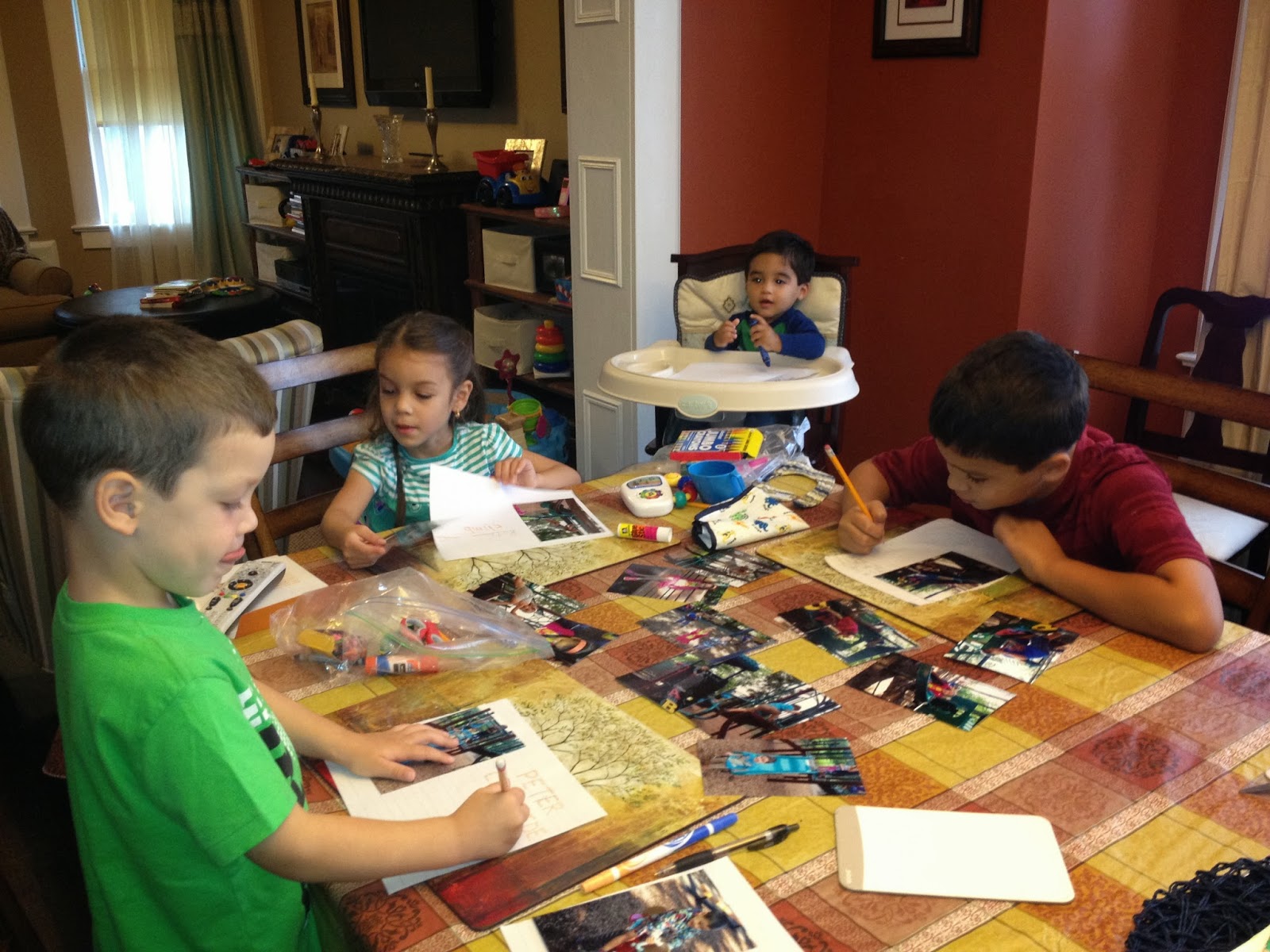
Raise the FLF: You can really turn the notch up for this activity by involving the whole family.  This summer I tried this with the kids I was watching plus my own son.  I was trying to develop literacy activities for children that ranged from 15 months to 9 years old.  Towards the end of the summer I knew it was time to turn up the interest dial.  I printed out some pictures from some of our park outings and we decided to make a book together.  They had so much fun sorting through the pictures (about 10 of them) and choosing which should go on their page.  To keep this realistic I only let each child do 3 pages, any more and it would stop being fun (mainly for me)!


Once each child chose 1 picture I asked them to add text that made sense for their age.  For the 4 year old, he dictated a simple sentence and I had him trace the one word I wanted him to focus on.  I also made a word box where he copied this word.  The 5 year old, dictated a sentence.  I wrote what she said but I left a blank for the 2 words I thought she could handle writing herself (for Katie it was her name and the word can), for the 9 year old, I asked him to write a paragraph.  I explained that his page would be the introduction to the book so we talked about main idea.  This sounds complicated but it took me about 5 minutes to set up and about 15 minutes of quiet working for each page...ahh quiet working an Auntie and Teacher's dream! I posted the pictures below:


Yes, even my son got in on the action... he loved "working" while his older cousins worked.  He practiced scribbling with his washable crayons and holding the leftover pictures in his hands. We practiced naming our favorite places in the pictures.   If interested, I can scan and upload our finished product.  We just slipped them into a dollar store presentation book.  Try this with your family after a family trip to the zoo or even with a regular's day worth of pictures.  You'll get your kid(s) reading AND have a great family memory book!

Thursday, August 22, 2013

Routines

I don't know if it is the teacher in me or if it just my personality but I am a big believer in routines, schedules, consistency, structure.  Don't get me wrong it is pretty difficult to follow these but I find comfort in my "plans."  This is especially true with kids.  As a classroom teacher I rely on these to create a safe and nurturing space.  As an Auntie watching 2 nephews (age 9 and 4), 1 niece (age 5), and my 15 month old son it is a necessity.  When my son was born I found the book, The Contented Little Baby by Gina Ford to be so calming because it suggested so many routines that I found helpful.  Granted when dealing with babies, kids, actually people routines have to be flexible but having a plan in place can help keep some thread of sanity in place- or at least it does for me!

I was thinking that this concept has been really helpful in creating a literacy rich environment for my son.  I am hoping that my son will discover and treasure the riches that reading has to offer.  As such I am trying to establish routines that help this dream get nurtured.  First off, let me recommend a book called The Read Aloud Handbook by Jim Trelease.  This book is a classic in explaining the value in reading to and with your child.  It also offers much advice, research, and resources.  I've gotten many of ideas from reading this book.

From the day my son was born I have been thinking about the ways that I can help him feel connected to reading.  I think that an important element is to make it a natural desire rather than a forced activity.  That is why routines are important.  For me, it is not realistic to plan for reading in the morning.  It is hard enough trying to get myself and my son dressed.  Instead I try to infuse reading by thinking of this time as a place for language to take center stage.  After all, a home rich in language exposes our children to vocabulary and sounds that they will rely on when learning to read.  On cheery mornings this may mean interactive songs while getting dressed.  On crankier mornings this might mean connecting words with functional items during breakfast; I might call out "cheerios", "oatmeal", or "eggs" as I see the words while making breakfast.  I often suggest these kinds of activities for families with reluctant readers.  Your child might be feeling anxious about trying to pick up an entire book and reading from it but may feel more successful hunting for familiar words in the kitchen, house, or while riding in the car.  Another great routine I once saw a parent of one of my previous first-graders use was drawing pictures and labeling them on her child's snack bag.  Often these were words that were on her child's spelling list.  However, this idea could be used in many ways by choosing your words or even simple sentences to connect to your child's needs.  This is one routine I know I will incorporate one day...well on the days I have my act together enough to make lunch/snack on time. ;)

Currently, I try to help myself infuse reading as a routine by having books in all the important niches of my home.  I try to have a "standard" book, that means my child recognizes that this book is always read in this particular room and then a variety of other books that flow freely throughout the house.  We have our special bathtime book, our kitchen "cookbook", our playroom book, etc.  My favorite "standard" is in my bedroom.  Although my son sleeps in his own room, in his crib,  there is nothing better than a lazy morning cuddle.  We don't get to do this often but when we do it always involves Pat the Bunny by Dorothy Kunhardt.  This classic is such a fun interactive book.  It is great for teaching your child to connect to text in an age appropriate way.  My son is always eager to turn each page and then participate in the action the same way the characters do.  He has learned so many concepts of print by reading along with this book.  It is a new discovery and level of confidence each time we pick it up.  Be warned though, it is so interactive that I have already found myself needing to buy a second copy.  Another great place for a "standard" and/or a routine is bedtime.  Since my son was born we have read him the same bedtime book.  For us it doesn't get any better than Goodnight Moon by Margaret Wise Brown.  The best part is that since we are raising our son to be bilingual, we are able to have this classic in both English and Spanish.  Each night we end with this book and then we say your turn...we then say good night (or actually "buenas noches") to some of his bedroom items.  This has helped to support his understanding of the story and to establish a particular bedroom routine. 

These ideas are just that ideas.  While they are good goals please realize that I do not mean to say you should do each of these things every day.  Life is just simply not that predictable.  Our dog-eared copy of Good Night Moon gets read almost every night but there are nights that we simply run out of time! On the other hand, there are nights we have extra time and are able to read several stories in addition to our standard.  The point is to look for small ways you can infuse predictable text into your child's day, alongside the discovery of new and ever changing stories, books, and language.

Raise the FLF: Don't forget to infuse this concept for the whole family.  Modeling a love of reading is the strongest way to nurture a life-long reader.  Let your child see you taking some time for yourself to read.  I think it is ok to have a magazine or book open as your child is playing nearby (as long as it is age-appropriate and safe).  Or better yet, engage your child in what you are reading.  Remember that scene in Three Men and A Baby where Tom Selleck reads to the baby from his financial magazine? That is actually a great practice.  At such a young age it is important for your child to be exposed to sounds and concepts of print but the "storyline" is less important so hey sometimes go ahead and read to them- from your own collection.  As your child gets older and your reading choices are less appropriate you can try this idea in different ways.  Read aloud from a recipe as you cook, take a walk in your neighborhood and read from signs as you go, read 1 or 2 sentences from your book or article and have a conversation with your child about it. 

Read as a family and your child will have so much to gain from the experience as he/she bonds with you and also expands their journey as a life-long reader.  

What routines do you and your family share?

Tuesday, July 30, 2013

What's In A Name?

The reason I titled this blog The Family Learning Factor is because that is the element that I think is the key component of promoting life long learning with your child.  As a teacher, I am obviously an ardent advocate of our schools.  I believe that the magic that can occur in the classroom can shape a child's whole landscape- academically, emotionally, socially.  That being said, I have also seen first hand that when a child's family is a family of learners the skies are the limit for the child! 

So what is family learning? Family learning is the idea that a child learns more deeply when the whole family is involved.  You've seen it- a father that is obsessed with motorcycles and what is the child into? Motorcycles! In a lot of ways this is what I would like to advocate more of, family learning together.  However, I'd like family to foster learning in areas that will complement the academic learning that is expected of our children in today's world.  

For you it may be science, math, building things, etc.  For me it is in 2 areas literacy and cultures.  Now granted this is totally biased.  As a primary school teacher I see literacy as the vehicle that can drive all good learning.  Then as part of my personality profile, travel and cultural studies are my passion.  But I think as parents it is only natural to make biased decisions.  To better explain what I mean let me share some background.  I am a bit of a travel addict.  I love traveling to other countries and learning about different cultures.  When I think about where I got this interest I don't think it came from my school projects.  I believe it came from a few really amazing family trips.  I'll never forget climbing the pyramids of Chichen-Itza with my family  OR the request for analysis that my dad threw at us over dinner that night. I'll always be grateful to my own Latin background which always kept minority interests close to my heart.  Now these were the power behind my passion.  However, boy did it complement my academic road! I'm a proud holder of a Master's degree in International Education.  I think at the end of the day you have to BE THE DREAM for your child, not just want it for them.  (Somewhere my big sis is rolling her eyes at me!) But what I mean is- if you want your child to be a reader, they have to see you read.  If you want your child to have an interest in science, they have to see you read about science, try a small science experiment together, go to a science expo.  If you want your child to be artistic they have to see you emerged in artistic expression.  If you want your child to be ______ they have to see you live and be _____.  I know this is easier said than done but our kids are worth a try!

So I ask:
What kind of family learning do you think is important for your family? I am curious if you also feel passionate about learning together as a family in a particular area. 

Sunday, July 28, 2013

Getting Real ...


In high school I remember connecting to a quote: "No one can do everything, but everyone can DO something."  While this may be an overused sentiment it is often what I use to inform my actions...then truthfully get into trouble as I try to "DO everyTHING" at the same time.  Parenthood is definitely turning out to be this scramble for me.  As an educator I have so many aspirations I'd like to help my child reach; as a neurotic individual I have so many "perfectly candid and natural" moments I'd like to manufacture.  However, my baby is already showing me that I can't plan or guarantee very much, if anything.  If I could my 15 month old son would already be walking! So in midst of trying to do it all, I'm trying to remind myself of that high school saying....

This brings me to think, if I can't do it ALL what do I want to do?!  Here is the takeaway for all parents- I think we need to ask ourselves "what are our core values that we'd like to instill?" Sure we'd like to do it ALL, you know mold the perfect child: well-rounded without even trying.  That mythical child that is well-mannered, yet cleverly mischievous; academically smart and artistically creative and a natural athlete; a child in an eternal good mood.  But we can't necessarily control outcomes, particularly in the lives of our children.  We can however, think about small things we can do to cushion their worlds with some of our core values.

For me, aside from the obvious happy and healthy, I'd really like my child to be a voracious life long learner.  I really want them to LIVE their life and I truly believe this can only happen if I surround my child in learning experiences that ignite curiosity in this crazy world of ours.  There you go- this blog is my attempt to share my experiences in this ambitious journey- things that work and things that have not worked for me! Also, I'm hoping that all of you care givers out there will share all your interesting learning experiences with me as well.  I'd love to hear about the things you are doing as a family that ignite your child's imagination and desire to continue their own learning.